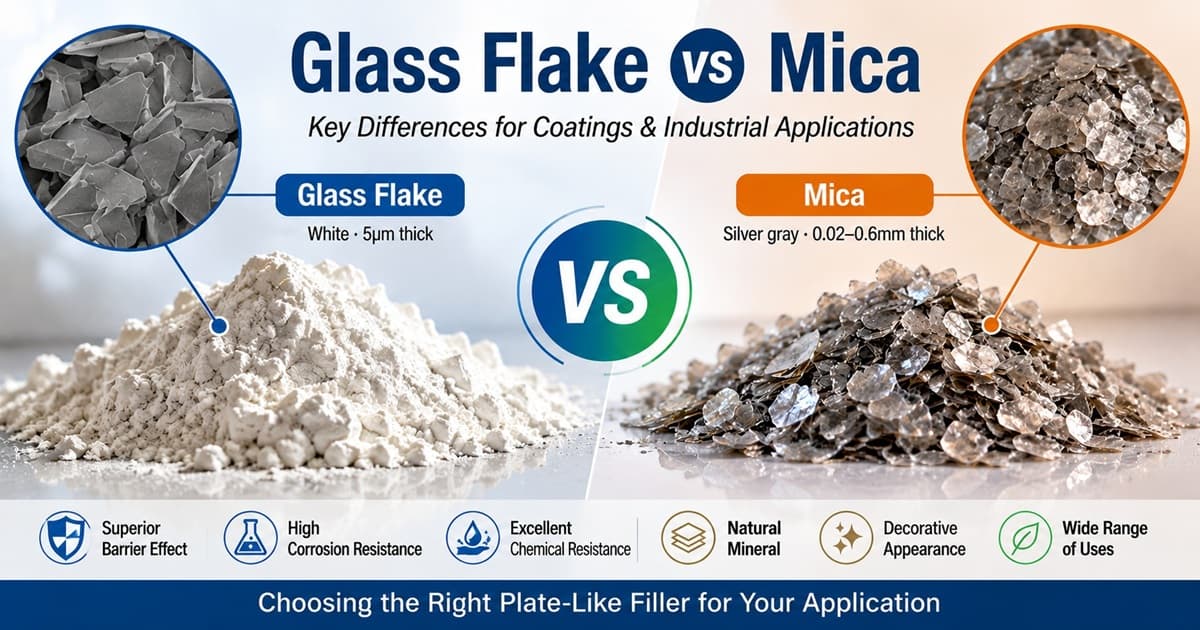
Glass flake and mica are both thin, plate-like fillers, but they are not interchangeable. Glass flake is a manufactured, ~5 μm-thin, 100%-glass platelet with a very high aspect ratio, giving superior barrier and chemical resistance for heavy-duty anticorrosion coatings. Mica is a thicker natural mineral best suited to decorative effects, general filling, and cost-effective reinforcement.
Glass flake and mica are both ultra-thin, plate-like materials widely used as functional fillers in coatings, plastics, cosmetics, and specialty applications. Because of their unique lamellar structure, both can improve coating performance by creating a barrier effect and modifying mechanical properties.
However, glass flake and mica are not interchangeable. Their differences in thickness, purity, chemical resistance, and reinforcement capability make them suitable for different applications. For demanding anticorrosive coating systems used in petrochemical plants, desalination facilities, offshore structures, and brine processing equipment, glass flake is often selected because of its superior barrier performance and chemical durability.
What Is Glass Flake?
Glass flake is a thin, flat glass particle manufactured by producing glass films and processing them into controlled-size flakes. Typical characteristics:
- Thickness: approximately 5 ± 2 μm
- Diameter options: average 600 μm, 160 μm, or 15 μm
- Material purity: 100% glass
- Color: white or gray
When incorporated into epoxy, vinyl ester, or polyester resin systems, glass flakes overlap like miniature plates, forming a dense barrier structure. This increases the path that water, oxygen, chloride ions, and chemicals must travel before reaching the substrate. As a result, glass flake coatings provide excellent corrosion resistance, low permeability, high chemical resistance, improved abrasion resistance, and better mechanical reinforcement.
What Is Mica?
Mica is a naturally occurring mineral group with excellent cleavage properties, allowing it to be separated into thin sheets. Common types include muscovite and biotite. Typical characteristics:
- Thickness: 0.02–0.6 mm
- Particle size: approximately 1680–250 μm
- Material purity: 97.0–98.5%
- Color: silver gray, gold, or greenish tones
Mica is widely used in drywall materials, paints and fillers, automotive components, roofing materials, electronics, cosmetics for shimmer effects, and food applications for visual effects. Like glass flake, mica can improve barrier properties, but its larger thickness and mineral composition result in different performance characteristics.
Similarities Between Glass Flake and Mica
1. Both Have a Plate-Like Structure
The most important similarity is their lamellar structure. Their flat particles overlap inside a coating matrix and reduce direct pathways for moisture and chemical penetration, creating a “tortuous path effect.”
2. Both Are Used as Functional Coating Additives
Glass flake and mica are used as additives to modify barrier performance, mechanical properties, surface appearance, and dimensional stability.
3. Both Have Long Shelf Life
Properly stored glass flake and mica products can have a shelf life of 20+ years, making them suitable for industrial inventory management.
Glass Flake vs Mica: Key Differences
The table below summarizes how the two fillers compare across the properties that matter most for coating selection.
| Property | Glass Flake | Mica |
|---|---|---|
| Material | Manufactured glass | Natural mineral |
| Thickness | 5 ± 2 μm | 0.02–0.6 mm |
| Typical Diameter | 600 μm, 160 μm, 15 μm | 1680–250 μm |
| Purity | 100% glass | 97.0–98.5% mineral |
| Color | White, gray | Silver gray, gold, green tint |
| Particle consistency | Highly controlled | Natural variation |
| Barrier effect | Excellent | Limited to moderate |
| Corrosion resistance | High | Medium |
| Chemical resistance | High | Depends on mica type |
| Reinforcement | Strong | Moderate |
| Industrial coating use | Heavy-duty anticorrosion | General fillers and appearance improvement |
Why Glass Flake Provides Better Corrosion Protection
1. Ultra-Thin Thickness
Glass flakes used in coatings are typically only about 5 microns thick, allowing many overlapping layers to form inside the resin. This creates a highly efficient barrier network.
2. High Aspect Ratio
The ratio between flake diameter and thickness is extremely high. A higher aspect ratio means a longer diffusion path, lower permeability, and better corrosion protection.
3. Chemical Stability
Glass is chemically inert and resistant to water, salt solutions, many acids, and industrial chemicals. This makes glass flake coatings suitable for aggressive environments.
Applications of Glass Flake Coatings
Glass flake reinforced coatings are commonly used in:
- Petrochemical industry: storage tanks, pipelines, chemical processing equipment
- Marine industry: offshore platforms, ballast tanks, marine structures
- Desalination and brine processing: seawater equipment, brine tanks, pumps and pipelines
- Power generation: cooling systems, flue gas desulfurization equipment
When Should You Choose Glass Flake Instead of Mica?
Choose glass flake when the coating requires:
- Long-term corrosion protection
- High chemical resistance
- Low water permeability
- Offshore or marine durability
- Heavy industrial service conditions
Choose mica when the application requires:
- Decorative effects
- Surface appearance improvement
- General filler properties
- Cost-effective mineral reinforcement
Conclusion
Glass flake and mica share a similar plate-like structure, but their performance differs significantly. Mica is a versatile mineral filler widely used in paints, plastics, cosmetics, and general industrial applications. Glass flake, with its ultra-thin structure, high purity, and controlled particle design, provides superior barrier performance for demanding anticorrosion coatings.
For industries such as petrochemical processing, desalination, marine infrastructure, and chemical storage, glass flake remains one of the most effective reinforcing fillers for extending coating service life.
For a deeper explanation of particle size, resin compatibility, and grade selection, read our guide to glass flakes for barrier coatings.
Frequently Asked Questions
Is glass flake the same as mica?+
No. Although both are thin, plate-like materials, glass flake is manufactured from glass while mica is a natural mineral. Glass flake provides higher corrosion protection and chemical resistance.
Why is glass flake used in anticorrosive coatings?+
Glass flake creates overlapping barrier layers inside the coating. These layers slow down the penetration of water, oxygen, chloride ions, and chemicals, improving corrosion protection.
Can mica replace glass flake in protective coatings?+
In general, mica cannot fully replace glass flake in heavy-duty anticorrosion coatings because mica has lower barrier performance and different chemical resistance characteristics.
What is the typical thickness of glass flake?+
Industrial glass flakes used for protective coatings typically have a thickness of around 5 ± 2 μm.
How long can glass flake products be stored?+
Under proper storage conditions, glass flake products can typically maintain performance for 20 years or longer.
Is glass flake environmentally stable?+
Yes. Glass is an inorganic material with excellent stability and does not degrade easily under normal industrial storage conditions.
Tell us your resin system and service environment, and our engineering team will recommend the right glass flake grade and surface treatment for maximum barrier performance — typically within 24 hours.