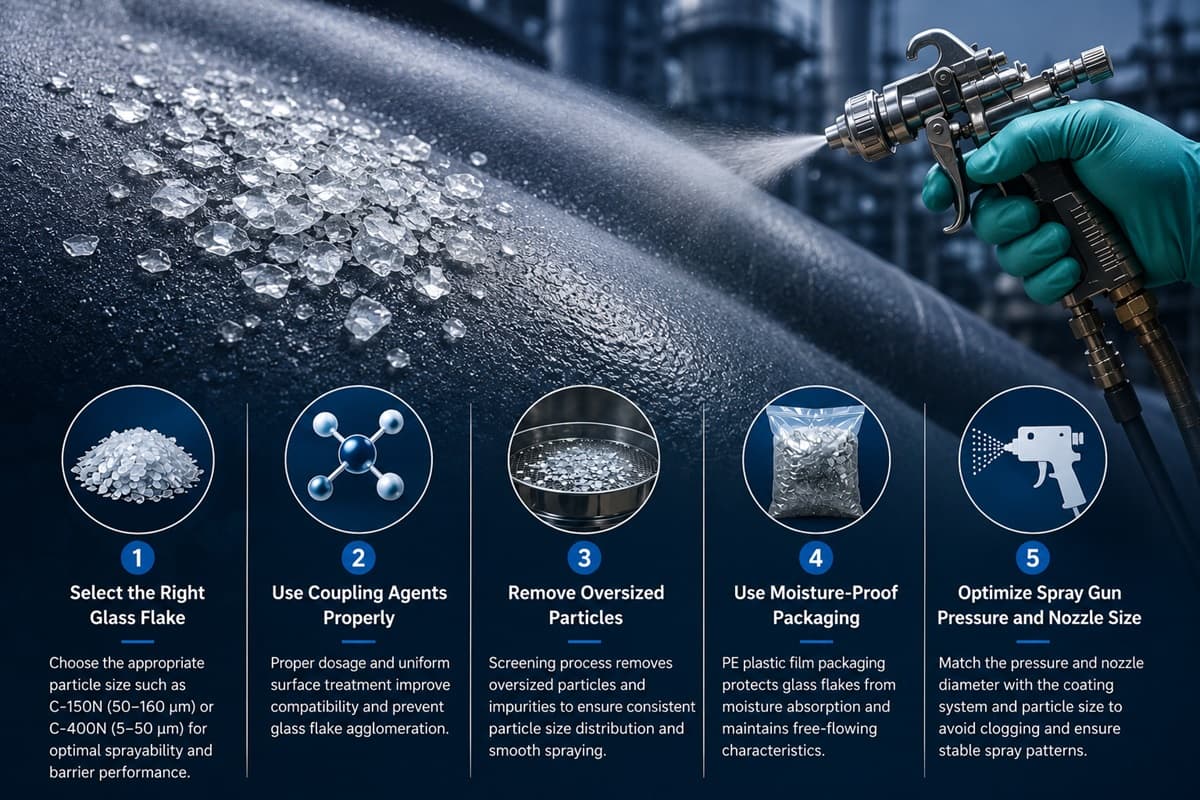
Spray nozzle clogging in glass flake coatings is prevented by controlling five things together: select the correct flake size for your nozzle (C-150N at 50–160 μm or C-400N at 5–50 μm), dose coupling agents correctly to avoid agglomeration, screen out oversized particles during production, use moisture-proof PE packaging, and match spray pressure and nozzle diameter to the coating system.
Glass flake coatings are widely used in heavy-duty anti-corrosion applications — marine structures, chemical storage tanks, pipelines, and industrial equipment. The barrier properties of glass flakes significantly improve coating durability by creating a tortuous diffusion path that slows the penetration of water, oxygen, and corrosive chemicals.
During spray application, however, one common challenge faced by coating manufacturers and applicators is spray nozzle clogging. Nozzle blockage can lead to uneven coating thickness, poor spray patterns, reduced production efficiency, increased maintenance time, and higher material waste.
In most cases, clogging is caused by a combination of factors: improper glass flake selection, insufficient dispersion, excessive agglomeration, oversized particles, moisture absorption, and unsuitable spray equipment settings. This article explains the key methods to prevent it.
1. Select the Proper Glass Flake Particle Size
The particle size distribution of glass flakes is one of the most important factors affecting spray performance. If the flakes are too large relative to the nozzle opening, they accumulate at the tip and cause blockage. Selecting the correct grade for the coating system and spray equipment is therefore essential.
C-150N Glass Flake
- Average particle size: approximately 150 microns
- Recommended particle size range: 50–160 μm
- Suitable for high-build anti-corrosion coatings, epoxy glass flake coatings, vinyl-ester systems, and heavy-duty protective coatings
C-150N provides excellent barrier performance while maintaining good sprayability when used with suitable spray equipment.
C-400N Glass Flake
- Particle size range: approximately 5–50 μm
- Suitable for spray coatings requiring finer particles, lower-viscosity coating systems, and applications with smaller spray nozzle openings
The finer distribution helps reduce the risk of nozzle blockage and improves coating surface smoothness.
Balance Between Corrosion Resistance and Sprayability
Larger flakes generally provide better barrier properties because they create a longer diffusion path inside the film. But excessively large particles increase the risk of spray problems. The optimal size balances barrier performance, coating viscosity, spray equipment capability, and required film thickness.
| Grade | Particle Size | Nozzle Guidance | Suitable Systems | Notes |
|---|---|---|---|---|
| C-400N | 5–50 μm | Smaller tips acceptable | Lower-viscosity systems, fine tips, gloss/thin-film primers | Lowest clogging risk; smoothest finish |
| C-150N | 50–160 μm | Larger openings recommended | High-build epoxy / vinyl-ester, heavy-duty anti-corrosion | Strongest barrier; needs adequate bore |
2. Use Coupling Agents Properly to Avoid Agglomeration
Coupling agents such as silane-based additives are commonly used in glass flake coatings to improve adhesion between flakes and resin systems. A properly selected coupling agent improves interfacial bonding, mechanical strength, chemical resistance, and coating durability.
However, excessive or improper use of coupling agents can create a different problem. During storage or mixing, excess coupling agent can cause individual flakes to stick together and form larger clusters. These agglomerated particles behave like oversized flakes and may block spray nozzles.
To avoid this problem:
- Use the recommended amount of coupling agent
- Ensure uniform surface treatment during glass flake production
- Avoid excessive moisture during processing
- Verify dispersion quality before coating application
Proper surface treatment should improve compatibility without causing particle bonding.
3. Remove Oversized Particles During Production
Controlling particle size distribution during manufacturing is critical. Even when the average particle size meets specification, a small amount of oversized particles may remain — and these can block nozzles, create unstable spray patterns, and cause uneven coating surfaces.
High-quality production therefore requires a controlled screening process. After production, flakes should pass through precision screening equipment to remove oversized particles, agglomerated flakes, and foreign materials. For spray coating applications, consistent particle size is often more important than average particle size alone.
4. Use Moisture-Proof Packaging to Maintain Quality
Glass flakes are inorganic, but improper storage can still affect application performance. During transport and storage, moisture exposure may cause particle agglomeration, poor dispersion in resin, increased coating viscosity, and spray nozzle blockage.
To prevent moisture absorption, use a layered packaging structure: a PE moisture-proof plastic inner bag inside a strong protective outer layer. Proper packaging maintains dryness, free-flowing characteristics, and consistent dispersion performance. In humid climates, moisture-proof packaging is essential for maintaining glass flake quality.
5. Optimize Spray Gun Pressure and Nozzle Size
Even with high-quality flakes, improper spray equipment settings can cause clogging. The spray system must be matched to the flake particle size, the coating viscosity, and the required film thickness.
Spray Pressure
Insufficient pressure can cause poor atomization, unstable material flow, and increased particle accumulation. Excessive pressure can cause excessive shear force, uneven coating distribution, and increased overspray. The recommended pressure depends on the resin system, the glass flake loading, and the spray equipment type.
Spray Nozzle Diameter
The nozzle opening should be sufficiently large to let flakes pass through. As a general guide, fine flakes (5–50 μm) may tolerate smaller nozzle sizes, while medium flakes (50–160 μm) need larger openings. Using a nozzle diameter that is too small relative to the flake size is one of the most common causes of blockage.
Cause & Countermeasure Summary
Use the following quick reference to diagnose and resolve recurring blockages on the line.
| Clogging Cause | Countermeasure |
|---|---|
| Flake too large for nozzle bore | Select a finer grade (e.g. C-400N) or open up the tip size |
| Agglomeration from excess coupling agent | Dose silane to spec; verify uniform surface treatment |
| Residual oversized particles | Precision screening during production |
| Moisture pickup in storage | PE moisture-proof inner packaging; keep sealed and dry |
| Mismatched spray pressure / tip | Tune pressure and nozzle to flake size, viscosity, and DFT |
Conclusion
Preventing spray nozzle clogging in glass flake coatings requires a combination of proper material selection, manufacturing control, packaging protection, and application technique. The key factors are: selecting the correct flake size such as C-150N (50–160 μm) or C-400N (5–50 μm); using coupling agents correctly to prevent agglomeration; removing oversized particles through screening; using moisture-proof PE packaging; and matching spray pressure and nozzle size to the coating system.
By controlling these factors, manufacturers and applicators achieve smoother spraying, reduce downtime, and maximize the corrosion protection benefits of glass flake technology.
Frequently Asked Questions
What causes spray nozzle clogging in glass flake coatings?+
Clogging is almost always a combination of factors rather than a single cause: glass flakes that are too large for the nozzle bore, agglomerated flakes from excess coupling agent or moisture, residual oversized particles left in the batch, poor dispersion in the resin, and spray equipment settings (pressure and tip size) that are mismatched to the coating. Addressing material selection, manufacturing control, packaging, and spray setup together is what eliminates blockages.
Which glass flake grade sprays best — C-150N or C-400N?+
C-400N (≈5–50 μm) is the finer grade and passes through smaller airless tips with the lowest clogging risk, giving a smoother surface — ideal for lower-viscosity systems and fine tips. C-150N (≈50–160 μm) delivers stronger barrier performance for high-build epoxy and vinyl-ester coatings but needs a larger nozzle opening. Choose based on your target film thickness, viscosity, and equipment: finer flake for thin films and small tips, larger flake for high-build heavy-duty coatings sprayed through wider bores.
What spray tip size should I use for glass flake coatings?+
The nozzle opening must be comfortably larger than the maximum flake dimension so platelets pass freely. Using a tip that is too small relative to the flake size is one of the most common causes of blockage. As a general rule, fine flakes (5–50 μm) tolerate smaller tips, while medium flakes (50–160 μm) require larger openings. Confirm the exact tip with your equipment supplier based on the grade, resin system, and required output.
Can too much silane coupling agent cause nozzle clogging?+
Yes. Coupling agents (e.g. silane additives) improve adhesion, mechanical strength, and chemical resistance, but an excessive or improperly applied dose can bridge individual flakes together during storage or mixing, forming clusters that behave like oversized particles and block the nozzle. Use the recommended dose, ensure uniform surface treatment during production, control moisture, and verify dispersion before application.
How should glass flakes be stored to prevent clogging?+
Although glass flakes are inorganic, moisture exposure during transport or storage promotes agglomeration, poor dispersion, higher coating viscosity, and ultimately nozzle blockage. Package with a PE moisture-proof inner bag inside a strong protective outer layer, and keep the product sealed and dry until use. In humid climates this packaging discipline is essential to preserve free-flowing, consistently dispersible flakes.
Why is consistent particle size more important than average particle size for spraying?+
Even when the average size meets specification, a small fraction of oversized particles or agglomerates is enough to block a nozzle and destabilize the spray pattern. Precision screening after production removes oversized flakes, clusters, and foreign material, so for spray application a tight, consistent distribution is more valuable than a nominal average alone.
Send us your resin system, spray equipment, and target film thickness. Our engineering team recommends the right flake grade, surface treatment, and packaging for clog-free application — typically within 24 hours.